Water Heater Leak Cleanup in New Braunfels, TX
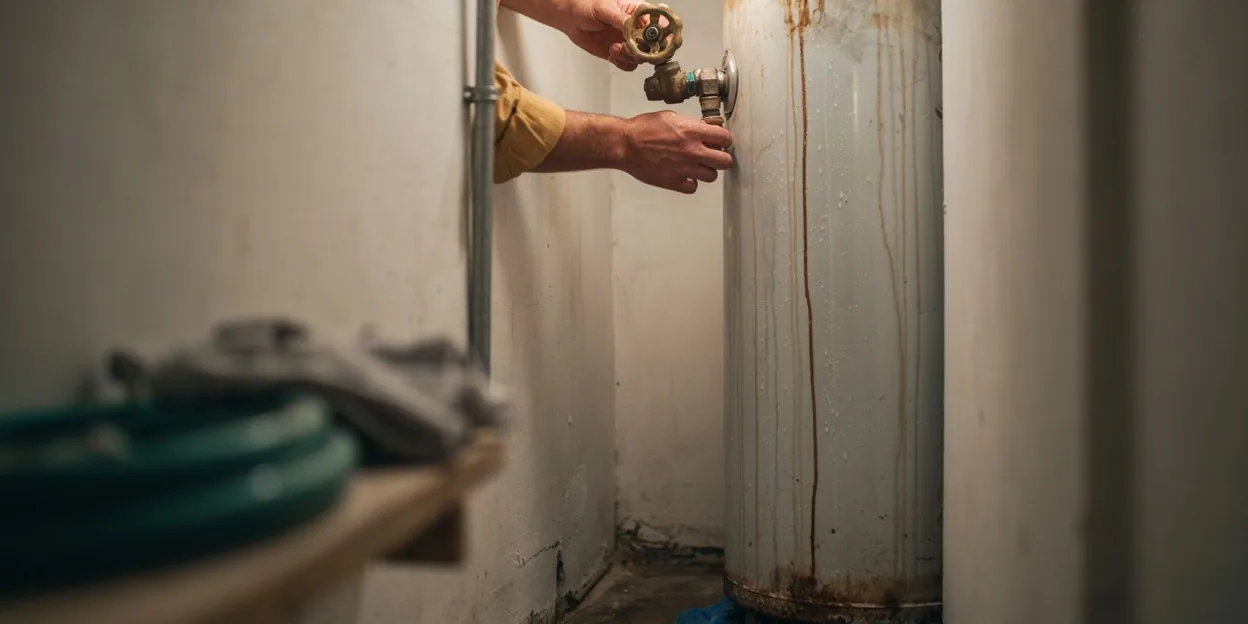
You noticed the shower running lukewarm last week and thought nothing of it. This morning there is a stain spreading across the ceiling of the upstairs landing, and when you pull down the attic stairs the air that comes out is warm and wet. The forty-gallon tank up there is twelve years old and has been sitting in a pan that was never piped to a drain. This site routes you to an independent local provider who cleans up water heater failures in New Braunfels and across Comal County.
Working under a tank that sits above the living room
The attic installation is what makes this loss different from a garage tank. The crew shuts the cold valve on top of the heater, confirms the tank is the source, and then maps where fifty gallons went: through the pan, into the insulation around it, along the top of the ceiling drywall, down the nearest wall cavity, and onto the floor of the room below. The wet insulation comes out first, because it holds water against the ceiling. The ceiling is opened at the lowest point, the wall below is metered, and the drying equipment goes into the attic as well as the rooms.
A garage or closet tank is simpler: extraction off the slab, then the wall bases and anything stored on the floor.
While the tank is still draining through the ceiling
Turn off the cold-water valve on the tank, and if it is a gas unit, turn the gas control to off. For an electric tank, switch off its breaker before anything else; a tank that drains with the elements on burns them out. Put a bucket under the drip and move anything under the stain. Do not open the attic stairs if water is running down them. Photograph the ceiling, the attic, and the pan if you can reach it safely. Then call and say whether the tank is in the attic, the garage, or a closet.
The parts under a dead tank that get replaced, and the parts that dry
The tank is replaced, which is a plumber's job. The insulation around it leaves. The ceiling drywall under the pan is usually replaced, because it sagged while holding water. The wall below often dries in place if it is opened at the bottom and the meter says so. Flooring on the level below is judged by the readings: tile usually stays, wood and laminate often do not. If a closet tank soaked the carpet in a bedroom, the pad goes and the carpet may be dried. The drying side is structural drying, and if the stain turns out to be a drain line or roof leak instead of the tank, the job becomes ceiling water damage repair with a different search.
Why Comal County eats water heaters
New Braunfels Utilities draws much of its water from the Edwards Aquifer, and it is among the hardest municipal water in Texas, well over 15 grains per gallon. Scale builds on the bottom of a tank, the steel under it overheats and corrodes, and tanks that last fifteen years elsewhere rust through in eight to twelve here. Builders in the two-story subdivisions from the late 1990s on, in Hunters Creek, River Chase, Mission Hills Ranch, and Johnson Ranch, put the tank in the attic to save floor space. A tank at that age, in that place, is the single most common cause of a ceiling stain in the county.
Tankless units mounted in the attic or garage fail differently, through a cracked heat exchanger or a frozen inlet, but the water still lands in the same place. The February 2021 freeze took out a large number of attic tanks and their supply lines at once.
A tank that fails suddenly is usually covered as a sudden loss; a pan that has been dripping for a year and rotting the ceiling slowly may not be. Nobody who has not read your policy can say, and this site makes no promise. The provider's photos of the pan and the attic are what the adjuster uses.
Calling about a warm attic and a wet landing
Say where the heater is, whether the water is off, and whether the ceiling is sagging. Mention a lukewarm shower, a hissing sound in the attic, or a pan that overflowed before. Have the address and a callback number. Call (830) 356-7502.